Visit of the Sultan of Oman reinforces cooperation with UNESCO
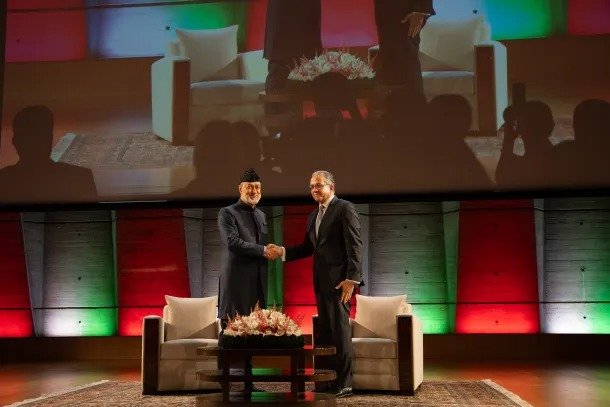
On the official visit of His Majesty Sultan Haitham bin Tariq, Sultanate of Oman, to UNESCO Headquarters in Paris, UNESCO Director-General Khaled El-Enany highlighted the strong and longstanding partnership between the Sultanate of Oman and UNESCO. This cooperation reflects Oman’s commitment to preserving cultural heritage, promoting education, and advancing sustainable development, in line with its national vision and UNESCO’s mandate.
This visit of His Majesty Sultan Haitham bin Tariq reflects the shared commitment of Oman and UNESCO to building bridges and promoting a future grounded in dialogue, knowledge, and cooperation. Through its diverse commitments and its tangible contributions, the Sultanate of Oman continues to position itself as a reliable and effective partner in multilateral work, reflecting the hospitality and wisdom of its people.
Khaled El-Enany
UNESCO Director-General
The Director-General added that this event marks a historic visit of special significance and a great honor, as it is not only the first visit by a Sultan of Oman to UNESCO since 1989, but the first visit by an Arab head of state to the Organization since the beginning of his mandate.
This visit embodies the Sultanate of Oman’s steadfast commitment to supporting this international organization and strengthening its role in upholding shared human principles and values. It also reaffirms the Sultanate’s strategic partnership with the international community in promoting dialogue among civilizations, fostering a culture of understanding and coexistence, and advancing sustainable development pathways that serve the stability and prosperity of peoples. Since joining UNESCO in 1972, the Sultanate of Oman has continued to play an active role in supporting the Organization’s mission and objectives.
Oman’s collaboration with UNESCO is particularly evident in cultural heritage preservation. The country is home to five UNESCO World Heritage Sites, including the Archaeological Sites of Bat, Al-Khutm and Al-Ayn, Bahla Fort, the Land of Frankincense, and the Aflaj Irrigation Systems. These sites underscore Oman’s historical significance and its long tradition of innovation and trade.
Oman also stands as a successful example of heritage preservation, notably with Bahla Fort, once inscribed on the List of World Heritage in Danger, and subsequently removed from the list after restoration efforts.
Beyond its country-based efforts to preserve cultural heritage, the Sultanate of Oman is also active on the international level, contributing to World Heritage programmes in Africa by supporting site nominations and capacity-building initiatives in countries such as Kenya and the Comoros, as well as supporting UNESCO’s crisis action in Lebanon.
Oman has also worked closely with UNESCO to safeguard its 18 elements of intangible cultural heritage. Traditions such as Al‑Bar’ah, Al‑Razfa, and maritime practices are actively promoted to ensure their transmission across generations and to strengthen national identity. This commitment is also reflected in the recent establishment of the UNESCO–Sultan Haitham bin Tariq Prize for the Safeguarding of Intangible Cultural Heritage.
The country is also home to two items inscribed on UNESCO’s Memory of the World Register, A’nuwniah Al kubra and the Maden Al Asrar Fi Elm Al Behar manuscripts, which highlight Oman’s rich documentary heritage and its historic role in maritime science and knowledge transmission.
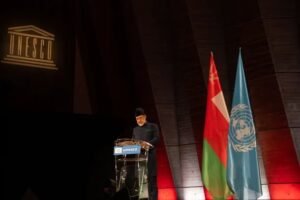
Education remains a key pillar of cooperation. Oman actively participates in UNESCO initiatives to improve educational quality and promote inclusive and lifelong learning. Its higher education institutions host nine UNESCO Chairs in fields ranging from artificial intelligence to cultural heritage, contributing to research and innovation. This commitment is further reflected in Oman’s engagement in global education dialogue and its recent ratification of the 1960 Convention against Discrimination in Education (June 2026). This underscores Oman’s active role within UNESCO’s institutional framework, contributing to international dialogue and promoting shared values of tolerance, intercultural understanding, and peace.
Oman’s partnership with UNESCO also extends to environmental sustainability, including biodiversity protection, water management, and climate resilience. The Aflaj systems exemplify the integration of cultural heritage and sustainable practices. The Sultanate is home to two Man and the Biosphere sites. In addition, the UNESCO/Sultan Qaboos Prize for Environmental Preservation further illustrates Oman’s longstanding and visionary support for international efforts to protect the environment and promote sustainable development.
This first visit marks an important milestone in the deepening of cooperation between Oman and UNESCO, reaffirming a shared commitment to promoting dialogue, preserving heritage, and advancing sustainable and inclusive development.